
Echoes of the Past and Figures of the Present
by Roméo Mivekannin
.
.
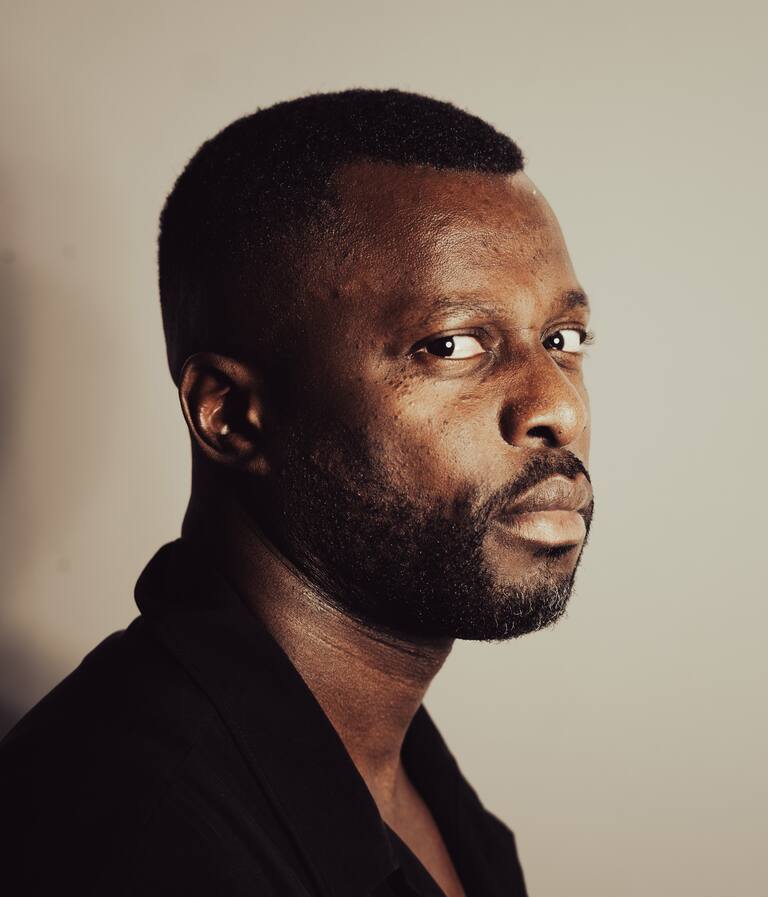
Roméo Mivekannin / Photo: Ulrich Lebeuf / Myop pour Liberation
.
In the landscape of contemporary African and diasporic art, Roméo Mivekannin occupies a singular place. A French-Beninese artist trained in cabinetmaking, art history, and architecture, he has spent several years exploring the zones of friction between colonial memory, Western iconography, and the spiritual traditions of the Gulf of Benin. His work follows a process that is both archaeological and ritual: it exhumes hidden narratives and diverts them through artistic practices that reactivate the symbolic charge of materials.
.
The use of worn sheets, stiffened fabrics, dyes, and ritual baths is never purely aesthetic for him. It constitutes a true protocol, almost liturgical, that inscribes each artwork within a long temporality, crossed by family lineages, Vodun beliefs, and the traumatic memories inherited from slavery and colonization. By reinterpreting images drawn from the history of European art, Mivekannin brings to light what classical representations relegated to the shadows: the presence of Black bodies, too often erased or instrumentalized.
.
In recent years, the artist has developed new series reflecting an expanded gaze toward other colonial and postcolonial geographies. His recent exhibitions revolve around large textile installations, paintings on black velvet, and works created in collaboration with local artisans. They draw on photographic archives, postcards, and recomposed historical images to question the ways societies have constructed—and sometimes ossified—the representation of the “Other.”
.
What stands out in the evolution of his practice is his ability to make the intimate and the political coexist. Each piece becomes a space of negotiation between his personal identity, collective memory, and the power structures that have shaped the Western gaze. By substituting his own face for that of the iconic figures he revisits, Mivekannin does not seek to impose an artistic ego: he positions himself within the continuity of the histories he aims to repair, proposing a visual reappropriation that transcends citation or pastiche.
.
On the international scene, Roméo Mivekannin asserts an increasingly prominent presence through projects that demonstrate the universal scope of his approach. His exhibitions have taken him to Africa, Europe, and even Madagascar, where he created monumental installations combining textile, metal, and iconography drawn from colonial archives. In Italy, he presented a series of velvet paintings that revisit the European pictorial tradition by confronting it with the spiritual heritages of the Gulf of Benin. In France, his work has entered major museum institutions, where his ritual fabrics enter into dialogue with the Western canon, revealing the invisible narratives that run through it. His participation in biennials and international exhibitions confirms the growing interest in a body of work that, while rooted in personal and spiritual memory, questions global constructions of the gaze and the shared histories between continents.
.
Today, his work is fully recognized internationally. His recent projects reflect a growing desire to situate his practice within varied museum contexts while continuing an exacting reflection on the role of images in our relationship to the past. Mivekannin is not merely an artist who revisits tradition: he reconfigures its foundations, compelling the viewer to see painting, photography, and the archive as spaces of struggle, memory, and reinvention.
.

After Jean-Étienne Liotard, Marie-Adelaide de France en Costume Turc (2025) / Acrylic and elixir bath on canvas / 198 x 220 cm
.
J.P.: Roméo, you were born in Bouaké, Côte d’Ivoire in 1986, and you are a descendant of Béhanzin, the last king of Dahomey. How does this family heritage influence your artistic vision and your commitment to deconstructing colonial narratives?
.
R.M.: The representations of Béhanzin and the royal family of Dahomey hold particular importance for me, because my grandmother was Béhanzin’s granddaughter. My artistic research has been accompanied by a personal quest into my roots and identity. This led to a series of works that are very significant in my trajectory, and they have been exhibited repeatedly in various geographical contexts—in Africa, Europe, and the Caribbean.
.
.

The Models of Art History, Les Demoiselles d’Avignon after Pablo Picasso II (2023) / Acrylic and elixir bath on canvas / 257 x 250 cm
.
J.P.: You are also a PhD candidate in architecture at the École Nationale Supérieure d’Architecture de Montpellier, with a dissertation on Postcolonial Africa and Contemporary Photography: Urban Spaces / Invisible Spaces. How does this academic research nourish your artistic practice?
.
R.M.: My academic research is closely intertwined with my personal research and my artistic practice. All of these aspects move forward together. The relationship to invisible space comes partly from that part of history about which we have no visibility—whether for technical reasons, such as the absence of images, or for psychological reasons, such as a form of denial.
.
Archival images from the colonial period often tell history from the perspective of the victors. They sometimes constitute the only photographic trace of the lives and individuals represented. By reappropriating these images, I complete them, I comment on them, and I create a new image.
.
I reverse these images in several ways. First, from the perspective of the gaze: in my works, it is the viewer who is looked at and questioned. Second, I invert the way we usually approach these images—often with a curious, anthropological gaze inherited from colonization. I then construct a new imaginary that inserts these images into a contemporary discussion. It is a way of deconstructing the image and the ideas associated with it that have reached us, consciously or not.
.
When I work with these archival images, I ask myself how to reveal the presence of what has disappeared. I have always been drawn to the question of the invisible, and this inquiry appears in my relationship to the sacred and to history.
.

Series The Models of Art History – Eleonora di Toledo after Bronzino, 2023, Elixir baths and acrylic on unstretched canvas, 168 × 137 cm


.
J.P.: Your work is distinguished by the use of worn sheets, traditional batiks, and burlap soaked in decoctions and spices. Can you explain the symbolism of these materials and their role in your creative process?
.
R.M.: My practice is multidisciplinary, combining painting, installation, ceramics, and other media. For many of my works, I use old sheets that I find in flea markets in Europe, particularly young women’s trousseaus. I soak these sheets—already charged with life and history—in elixirs mainly from Benin, which themselves carry magic and spirituality. It is on this material, at the crossroads of Europe and Africa, that I paint works inspired by Western iconography.
.
.
J.P.: You revisit masterpieces of Western art—such as those by Rembrandt, Géricault, Delacroix, or Manet—by incorporating your own image into them. What meaning do you attribute to this substitution of faces, and how does it challenge historical representations of Black bodies?
.
R.M.: The self-portrait in my work is a means of transfer, like an actor who becomes the vessel for the message he carries. I seek to introduce subversion and to shift the gaze, while echoing the existing compositions.
.
.


.
J.P.: You explore the place of Black people in the history of art and Western iconography. What historical realities are you seeking to highlight through your works?
.
R.M.: The history of Béhanzin and the last kingdom of Dahomey was the starting point of my artistic and personal research. This led to many chapters that question, among other things, the representation of Black people in Western art, which played a central role in shaping the Western and global psyche. Today, this manner of representing Black people in art and iconography—particularly photography—continues to shape the contemporary gaze through artworks and images. This is a dynamic that I question and to which I try to contribute within a global discussion.
.
.
J.P.: Your installation Atlas, presented at Art Basel, critiques colonial museums and their legacies. Can you tell us more about this work and its impact?
.
R.M.: With Atlas, I have been pursuing for several years a reflection on the heritage of major European and American architectures, such as the Grand Palais in Paris, London’s Crystal Palace, or the Tervuren Museum in Brussels. I chose to strip these buildings of their ornamentation to preserve only their primary structure—the forged metal skeletons suspended in space. I aim to reveal the nakedness of these monuments, usually symbols of power and prestige, in order to confront their beauty with the violence of their history.
.
My interest lies particularly in buildings linked to the colonial period, once used to display imperial grandeur, exhibit “human zoos,” or present looted objects and artworks. These places embody an ideology of domination and appropriation that I seek to lay bare, question, and invert. By representing them at a reduced scale and hanging them at varying heights, I invite the viewer to free themselves from the perspective imposed by these architectures of power and to rediscover their fragility.
.
.

View of Roméo Mivekannin’s exhibition in the Glass Pavilion of the Louvre-Lens Museum, 2025
.
.
J.P.: In your exhibition Correspondances in Madagascar, you collaborated with local artisans. How did this collaboration enrich your artistic vision, and what dialogue did you establish between your respective practices?
.
R.M.: Malagasy artisans and their exceptional expertise enriched the works with a depth that could only have been created in Madagascar. By bringing together embroiderers and metalworkers, the works pass from hand to hand and become infused with what these artisans bring: their lived experience, their sensitivity, and their depth.
.
.
J.P.: You have participated in international events such as the Dakar Biennale, Art Paris, and the 1-54 Fair in Paris at Christie’s. How have these experiences influenced your path and your recognition on the global art scene?
.
R.M.: These events—fairs and biennials—offer the opportunity to present my work to a very large audience within a very short timeframe. It is often a moment that is both very interesting and very intense, because through my works I reveal deeply personal aspects that I submit to everyone’s gaze. These events are also places of encounter with key figures of the art world, and they play a very important role in my journey.
.
.

Young Lady at the Mirror after van Mieris (2023) / Acrylic and elixir bath on canvas / 173 x 141 cm


.
J.P.: What are your future projects? Are you considering new collaborations or artistic explorations, particularly in the field of abstraction or other forms of expression?
.
R.M.: I am preparing an exhibition that will open at the end of November at the Kunsthalle Giessen, in dialogue with Germany’s history and in particular with the ambivalent status of artists in a totalitarian context. This is an aspect of my research that I have been working on for years.
.
There will also be a solo exhibition of my work at the Musée du Quai Branly in November 2026, which will question the museum’s complex colonial legacy.
.
I have already produced series of abstract and ceramic works, presented in part at the Louvre-Lens Museum in 2024–2025 and at Galerie Cécile Fakhoury in Paris.
.
.
.
J.P.: Finally, what message do you wish to convey to the public through your art and your engagement?
.
R.M.: I don’t necessarily place expectations on the audience. Undoubtedly, my works provoke reflection and questions. I believe that art contributes to the life of the city, much like theater. Art cannot change the world, and an artist cannot change the world alone, but they can contribute to it…
.
.
J.P.: Thank you.
.

6 Personnages (2023) / Acrylic and elixir bath on canvas / 178 x 135 cm
.
.
.
Learn more :
.
.
Roméo Mivekannin is represented by galleries :
.
.
.