
Sharing is One of the Most Important Aspects of Art
.
Interview with
Rita Pivoriūnaitė and Laurent Asscher
.
.

JEFF KOONS
Hulk Elvis Serie (Rock), 2004-2013
polychromed bronze and marble
©Jeff Koons, Courtesy of the artist and AMA Collection
Installation view by Sebastiano Pellion di Persano
.
On April 9, a new contemporary art center, AMA VENEZIA, opened its doors to the public in Venice—bringing with it a touch of Lithuanian influence. The center was founded by Laurent Asscher, one of the world’s leading art collectors, and his partner, Rita Pivoriūnaitė. The AMA Collection is recognized as one of the most significant private contemporary art collections in Europe, distinguished by its focus on conceptual and abstract art, as well as works by internationally acclaimed artists.
.
The vision behind AMA VENEZIA is to create a space where exceptional artworks can be shared with a wide audience. Laurent Asscher, who began collecting art in 2012, believes in the importance of supporting contemporary artists and fostering discussions around contemporary art. This space will not only showcase the AMA Collection, which focuses on contemporary art from the 1960s to today—placing particular emphasis on American artists—but will also serve as a hub for creativity, inspiration, and experimentation. AMA will provide artists with the opportunity to push boundaries and create extraordinary works.
Ahead of the official opening of this new artistic landmark, Laurent and Rita share their thoughts and future plans.
.

Rita Pivoriūnaitė and Laurent Asscher
.
J.P.: Laurent, you are recognized as one of the most influential contemporary art collectors in the world. What led you into the art world and inspired you to build your own collection, which includes works by such renowned artists as Jean-Michel Basquiat, Cy Twombly, Brice Marden, Rashid Johnson, Alexander Calder, Lucio Fontana, Rudolf Stingel, and others?
.
Laurent Asscher: I’ve always been surrounded by paintings from my childhood. My parents were collectors, and I grew up with Basquiat, Joan Mitchell, and Sam Francis on the walls. This nurtured my taste for contemporary art, especially American contemporary art. Traveling frequently to the United States for business over many years, I developed my art culture there. That’s why my collection is predominantly made up of post-war American artists, particularly from the 1960s to today, including the names I mentioned. Lucio Fontana is one of the few exceptions as a European artist.
.
J.P.: Your collection highlights contemporary artists and conceptual works. How do you approach collecting art? Are you guided by personal intuition, or do you conduct in-depth research on the art market and current trends before each acquisition?
.
L.A.: I believe intuition plays a major role for every collector, as each of us has different sensibilities. Some are drawn to figurative art, others to abstraction. Personally, I tend to collect abstract works, although I do have some figurative artists in my collection. It all starts with what moves me—what I’m drawn to emotionally. Then, of course, I conduct thorough research on the artist, their work, their background, and their trajectory. Whenever possible, I meet the artist, which is always insightful to better understand both the market and the depth of their practice.
.
J.P.: Your collection is impressive. When did you realize that it was ready to be presented to the public?
.
L.A.: My collection now includes over 200 works, and I believe that at some point, every collector feels the need to share their pieces. There’s nothing more selfish than keeping masterpieces hidden away in freeports, storage units, or closed homes. Some choose to lend their works to museums, while others—like me—decide to open spaces accessible to the public. I think it’s a natural evolution for any collector. What has changed compared to 20 or 30 years ago is that, back then, foundations or art centers were often created posthumously by heirs. Today, for the past fifteen years or so, collectors want to do it during their lifetime to better share their passion. I truly believe sharing is one of the most essential aspects of art.
.
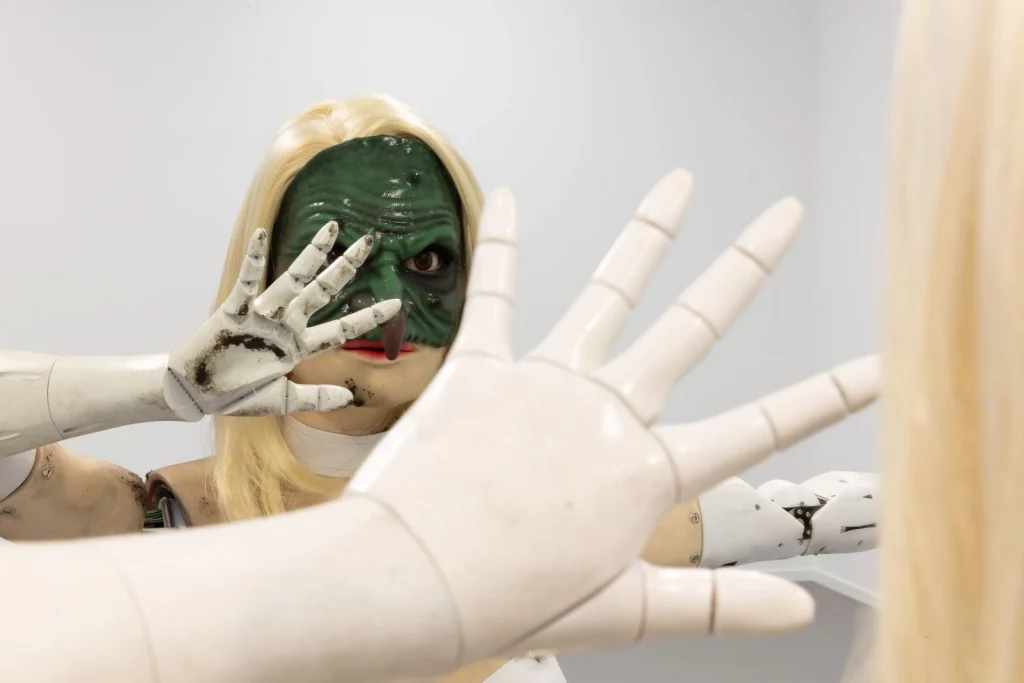
JORDAN WOLFSON
Female Figure 2014
mixed media
©Jordan Wolfson, Courtesy of the artist and AMA Collection
Installation view by Sebastiano Pellion di Persano
.
J.P.: Rita, in Lithuania, you are well known in the sports field as a multiple-time European full-contact karate champion and a world championship medalist. How did art become a part of your life?
.
Rita Pivoriūnaitė: Art has always been present in my life—I grew up in a home where the walls were adorned with contemporary Lithuanian art. My mother was interested in art and encouraged me to visit exhibitions, and I received my first practical training at the Vienožinskis Art School. However, I truly immersed myself in the art world after meeting Laurent—his passion for art is contagious. He introduced me to the international contemporary art scene, and I am very fortunate to learn from the best. Living among works by Basquiat, Twombly, Picasso, Marden, or Serra is not just a privilege but also a constant source of inspiration to explore, learn, and understand. It’s simply impossible to remain indifferent.
.
J.P.: Does your partner Laurent Asscher’s contemporary art collection reflect your artistic taste as well? How do you expand this collection—do you make decisions about new acquisitions together?
.
R.P.: Absolutely—our tastes align in most cases, I would say up to 90%. Before acquiring new works, we consult each other, discuss, and present our arguments. Laurent always asks for my opinion. Sometimes, of course, I have to say, “I just don’t get it,” but that’s also part of the process.
.
J.P.: Laurent, your collection includes many conceptual art pieces, which are often associated with institutional acquisitions. Did you take a long time to develop the idea of creating your own art institution, like AMA Venezia, to share these works with the public?
.
L.A.: At first, I acquired part of a palazzo in Venice that allowed me to display large-scale paintings—the high ceilings and grand salons in Venice are ideal for that. I opened this apartment to the public several times so people could visit. But over time, the space became too small, not flexible enough, and I realized it was only a step toward something more ambitious: creating a true public space, which is what AMA Venezia represents. In a way, it’s the final and most meaningful stage of that journey.
.
J.P.: Rita, you have played a significant role in the creation of the soon-to-open contemporary art center AMA Venezia. What challenges and discoveries accompanied the development of this museum in a historic location in Venice?
.
R.P.: Setting up any space in Venice is a major challenge due to multiple factors—from logistical issues (since there are no cars in the city) to natural conditions like the threat of rising water levels. AMA Venezia is located in a historic building in the Cannaregio district, on Fondamenta de Ca’ Vendramin, near Scuola Grande della Misericordia. The 1,000-square-meter space was fully restored while preserving its unique character. This building holds deep historical significance—it is marked on Jacopo de Barbari’s famous 1500 map of Venice. Archaeological research revealed several furnaces on-site, suggesting it was part of an industrial complex. Later, it became the Venice Soap Factory.
.
AMA Venezia is a unique architectural site that required a complete renovation, but we managed to maintain its authenticity and historical spirit. Now, this space is reborn as a contemporary art center, dedicated to exhibitions, site-specific projects, and international cultural dialogue.
.
I am deeply involved in AMA Venezia—not just in its creation and curatorial decisions but also in its day-to-day operations. Both Laurent and I want AMA Venezia to be more than just an exhibition space; we envision it as a vibrant cultural center that inspires, connects, and provokes thought.
.

AMA VENEZIA
.
J.P.: Why did you choose Venice as the location for your new art center, and what goals did you set for the museum’s renovation?
.
L.A.: With its rich cultural heritage and vibrant art scene, Venice was a natural choice. The city is becoming a hub for art and cultural foundations, providing the ideal environment for AMA Venezia to thrive and contribute to Venice’s artistic landscape. Located in the heart of Venice, near Scuola Grande della Misericordia in the Cannaregio district, AMA Venezia will offer more than 1,000 square meters of exhibition space.
.
The renovation process was entrusted to TA Torsello Architettura, a studio specializing in the restoration of architectural and cultural heritage. Their task was to create a harmonious dialogue with the past while revitalizing a previously unused space in an extraordinary way.
.
J.P.: Laurent, what does it feel like to see your art center, AMA Venezia, about to open its doors to visitors? Is this the realization of a long-held dream, or just another milestone in your journey through the art world?
L.A.: The opening of AMA Venezia is a true achievement. Additionally, ‘AMA’ carries the initials of my three children: Andrea, Matteo, and Alessandro. It’s like a child being born, exactly the size and shape I dreamed of. So it’s a realized dream, one that will surely evolve in its programming and the way we present art in the coming years. But for now, it brings a profound sense of joy and wonder.
.
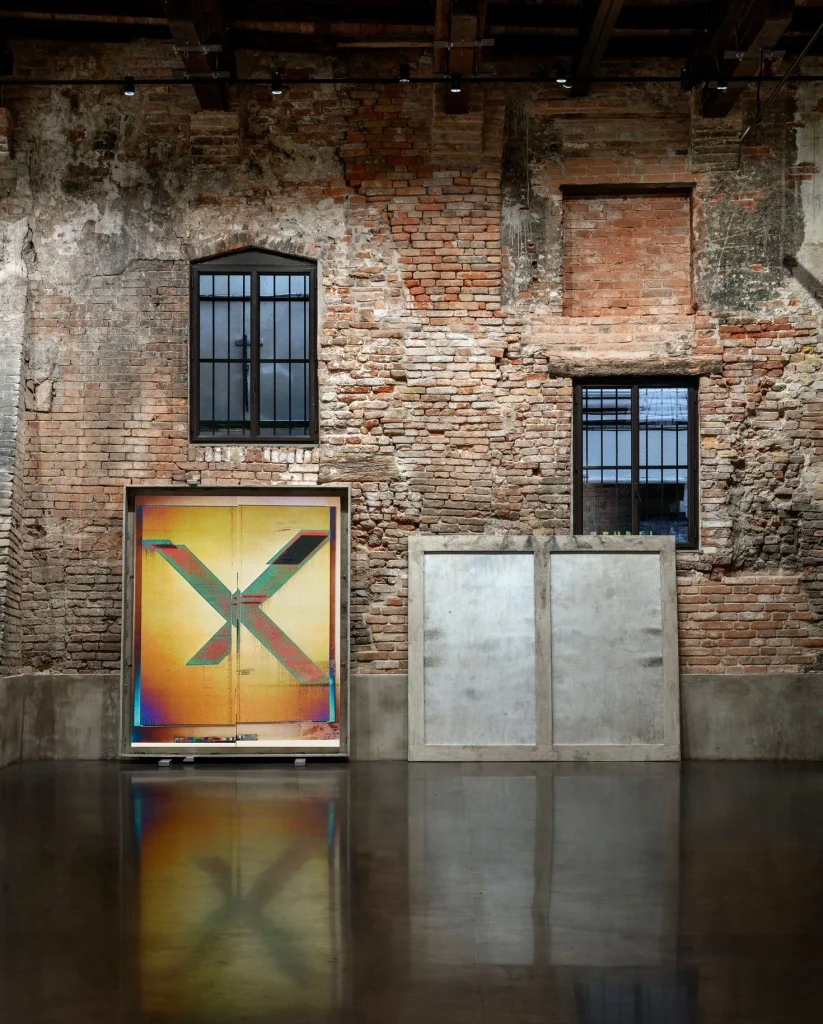
WADE GUYTON Untitled, 2021 Epson UltraChrome HDX inkjet on linen Untitled, 2024 Cast Aluminium ©Wade Guyton, Courtesy of the artist and AMA Collection Installation view by Sebastiano Pellion di Persano
.
J.P.: What are the future plans for AMA Venezia? Do you see opportunities to include Lithuanian artists in the museum’s collection or exhibition plans?
.
R.P.: Absolutely. I am introducing Laurent to Lithuanian art and artists – our conversations about them are becoming more and more frequent. I have no doubt that soon there will be works by Lithuanian artists in the collection. I really want Lithuanian art to be visible in an international context, and AMA Venezia could be a great platform for achieving that.
.
L.A.: The contemporary art scene in Lithuania is quite vibrant, we discuss this quite often with Rita. There are artists I’ve encountered in Paris, like Paulius and Svajone Stanikas (SetP Stanikas) at the Embassy, as well as others such as Rute Merk who are exceptional. All these artists definitely deserve to be part of the best European collections, including AMA collection.
.
J.P.: Thank you.
.
.
.
The opening exhibition is featuring works by Avery Singer, Brice Marden, David Hammons, Elizabeth Peyton, Florian Krewer, Jacqueline Humphries, Jeff Koons, Jordan Wolfson, Lauren Halsey, Mohammed Sami, Refik Anadol, Rudolf Stingel, Salman Toor, and Wade Guyton.
.
Wednesday–Sunday | 11:00–18:00 | Free admission
Fontamenta de Ca’ Vendramin, 2395, 30121 Venice | Vaporetto stop: Ca d’Oro
www.ama.art | info@ama.art
.