
The Invisible Thread Linking Yesterday and Today
.
Agnès Thurnauer
.
.

Agnès Thurnauer. Photo: Philippe Chancel
.
Agnès Thurnauer is a French-Swiss contemporary artist, born in Paris. A graduate of the École nationale supérieure des arts décoratifs, she has developed a singular body of work blending painting, installation, sculpture, and language. Very early in her career, she explored painting as a space for reflection and dialogue, addressing temporality, the gaze, and the status of women in the history of art. Her first series, such as Big-Big & Bang-Bang or Portraits grandeur nature, made a strong impression for their ability to question art and society while playing with writing and imagery.
.
Her work is defined by the richness of her artistic experimentation: she uses molded letters, painted words, and monumental formats, creating installations in which abstraction, figuration, and language respond to one another. These works, combining subtlety and boldness, offer viewers both a sensory and intellectual experience.
.
Over the course of her career, Agnès Thurnauer has exhibited in major institutions, among them the Palais de Tokyo and the Centre Pompidou in Paris, SMAK in Ghent, the LAM in Lille, the CCCB in Rio de Janeiro, and the Musée d’Art Moderne de la Ville de Paris. Her works also belong to numerous public and private collections in France and abroad. Recognized for their boldness and depth, her creations have secured her place among the leading figures of contemporary art.
.
.
Her current exhibition at the Musée Cognacq-Jay, Correspondances, particularly captivated me. It offers an unprecedented dialogue between her contemporary work and eighteenth-century art, shedding new light on the period and highlighting its continued resonance today. The exhibition brings Thurnauer’s creations into conversation with masters such as François Boucher, Jean-Honoré Fragonard, Antonio Canal—known as Canaletto—as well as emblematic women artists like Adélaïde Labille-Guiard, Louise Élisabeth Vigée Le Brun, and Angelica Kauffmann. But it also establishes a correspondence with women writers and scientists, including Madame de Staël and Émilie du Châtelet, revealing an unexpected network of dialogues among art, history, and thought.
.
In this interview, Agnès Thurnauer looks back on her journey, her practice, and the way she constructed this unique dialogue with the eighteenth century, oscillating between “responding” and “resonating” across time and perspectives.
.
.

Agnès Thurnauer in her studio
.
J.P.: You describe yourself as a visual artist working across painting, installation, sculpture, and language. You studied at the École nationale supérieure des arts décoratifs, with training that included film and video. How did this “multimedia” background nourish your artistic practice? How would you describe the evolution of your approach from your early days to today?
.
A.T.: Even before entering art school, I had been painting since childhood. Like some children, I had a very early vocation: I always knew I wanted to be a painter, and I never seriously considered anything else. The term “visual artist” is not the one I prefer; I feel above all like a painter. But if I simply say “painter,” people sometimes have trouble imagining that this can also encompass drawing, language, installations… Yet all of that, for me, is part of painting.
.
After high school, I entered the École nationale supérieure des arts décoratifs, but I already had a studio, and my life was already organized around painting. I was rather shy, and I worked a lot on my own, in a large, somewhat rudimentary space with no heating, but it was my workspace, my world. Entering art school was a way to open myself to my generation, to meet other artists, to step out of that isolation a little.
.
I chose to pursue a degree in film and video precisely because I didn’t think anyone could really teach me how to paint—painting was already my practice. I was interested in cinema for other reasons: framing, light, the relationship to time. Many filmmakers, like Godard for example, have a true painter’s eye. For me, the connection between painting and cinema is very strong: painting, too, is an image in motion, because it unfolds in the viewer’s gaze, in the time of the person who looks at it.
.
.
J.P.: The exhibition offers an unprecedented dialogue between your contemporary work and eighteenth-century art. What were your initial intentions when you accepted this carte blanche?
.
A.T.: My first intention, in accepting this carte blanche, was to understand what the eighteenth century truly was. It was probably the only century in art history that I didn’t know well and about which I had many preconceived ideas. I had the impression that I wasn’t very interested in this period, in part because of the representation of the female body, which is often highly objectified in the work of artists like Boucher, for example.
.
But this invitation allowed me to discover a century far more complex, creative, and rich than I had imagined. I realized how significant it had been for the status of women: many women artists, painters, and scientists played decisive roles during this time, seeking to claim their place in society and in history.
.
This discovery was, for me, emblematic of the fact that art history is a living field: the more one looks at it, the more it transforms, and the more new things one finds within it. While working on this project, I experienced a kind of reversal: what I thought I knew, I rediscovered, and this century I believed to be distant turned out to be fascinating. It allowed me to enter into a genuine dialogue with it, especially around questions of the gaze and the status of women in society.
.
.
J.P.: The exhibition is built on a dialogue between your works and those of the eighteenth century—a dialogue that is both aesthetic and intellectual. How were the pieces selected? Did you participate directly in choosing the older works with which you wanted to establish this visual conversation?
.
A.T.: Yes, absolutely, and that part of the project truly fascinated me. It was Saskia Ooms who invited me, and we visited the museum together. During that first visit, certain works immediately stood out to me as obvious choices.
.
I clearly remember discovering the Canaletto and instantly knowing which pieces of my own work could enter into dialogue with it. The second revelation was Fragonard’s Perrette and the Pot of Milk: I immediately thought of my large drawings, which I had never really shown before, and I felt that the encounter would work perfectly.
.
From these initial choices, the project developed organically. Saskia then suggested including an essential eighteenth-century work: Boucher’s Odalisque. That was very important, because this image corresponded exactly to the idea I had of the eighteenth century before discovering its complexity. It allowed me to confront that perception with my piece Sleepwalker, which, in its own way, dialogues with the gaze cast upon the female body.
.
And then there were wonderful discoveries: the loan of the painting representing Émilie du Châtelet, for instance, absolutely fascinated me. From there, a very precise scholarly process began—completing the museum’s collection with additional loans, such as the marvelous portrait of Angelica Kauffmann obtained from a museum in Berlin.
.
So no, it wasn’t improvised at all: there was a true curatorial process, very rigorous, based on my initial intuitions and Saskia’s museographic expertise.
.
.

On December 26, 2024, in the studio, with the museum model.
.
J.P.: The title Correspondances suggests a relationship, an exchange. What are you seeking to make “respond” or “resonate” between your works and those of the eighteenth century?
.
A.T.: This idea of “responding” or “resonating” is interesting. In fact, Correspondances is not a title I chose myself: it was proposed by Saskia Ooms, the exhibition’s curator, and I find it very fitting. The word evokes both exchange—like in an epistolary correspondence—and dialogue, this way of trying to understand one another through letters, of finding common ground, a shared space.
.
In the exhibition, there is of course this idea of response: for example, I “respond” to Boucher’s painting with my work Sleepwalker. There, the female body is no longer represented as an object but as a subject at work, immersed in the studio space at night—during that moment when one revisits what was done during the day. “Responding” is a very good verb. It expresses reaction, dialogue, and continuity all at once. To respond is not to oppose; it is to enter into relation, to make the other exist through one’s own voice. When I “respond” to an eighteenth-century painting, I am not trying to correct it or judge it, but to open a space where our two languages — that of the eighteenth century and my own — can meet.
.
But it is also a matter of resonance: this response is not closed; it circulates and creates further echoes — in the viewer, between the works, within the exhibition space. It is a polyphony. My work to Simon thus dialogues with Boucher’s Odalisque: it questions the status of women in the eighteenth century, but also today. It also resonates with the two white marble sculptures displayed in the same room.
.
There is a kind of polyphony, with all these voices speaking together. What I would like is for the exhibition to be like a choir — a gathering of voices that respond to one another, relay one another, sometimes contradict one another, yet form a shared melody: that of dialogue between eras and perspectives.
.
.
J.P.: The museum itself, the Musée Cognacq‑Jay, is housed in a private mansion in the Marais, with its refined eighteenth-century collections, its objects, furniture, narrow corridors, small rooms, and staircases. How did this historic space influence your choices, both spatially and conceptually?
.
A.T.: There was a real magic in working in this place—you don’t control everything, and that’s what makes it so exciting. One very important thing, which I believe contributed greatly to the success of the exhibition, is that when I arrived at the museum, the rooms were painted blue and adorned with moldings everywhere.
.
I quickly told the team that we needed soft colors—particularly a powder pink—and that we needed proper picture rails, because otherwise, hanging my works on rods alongside eighteenth-century works would have been problematic. Without this subtlety, if my works were hung on rods next to eighteenth-century pieces, the audience might have lost the thread. I was afraid it would feel too nightclub-like, too “boscopic.”
.
We worked with absolutely fantastic exhibition designers. I suggested the pedestals and specific display devices that became the structure of the exhibition. These elements created a kind of “box within a box,” ensuring both the readability and coherence of the dialogue between the eighteenth century and my work. This scenography was essential: it connects my works with those of the old masters while preserving the museum’s space and delicacy.
.


.
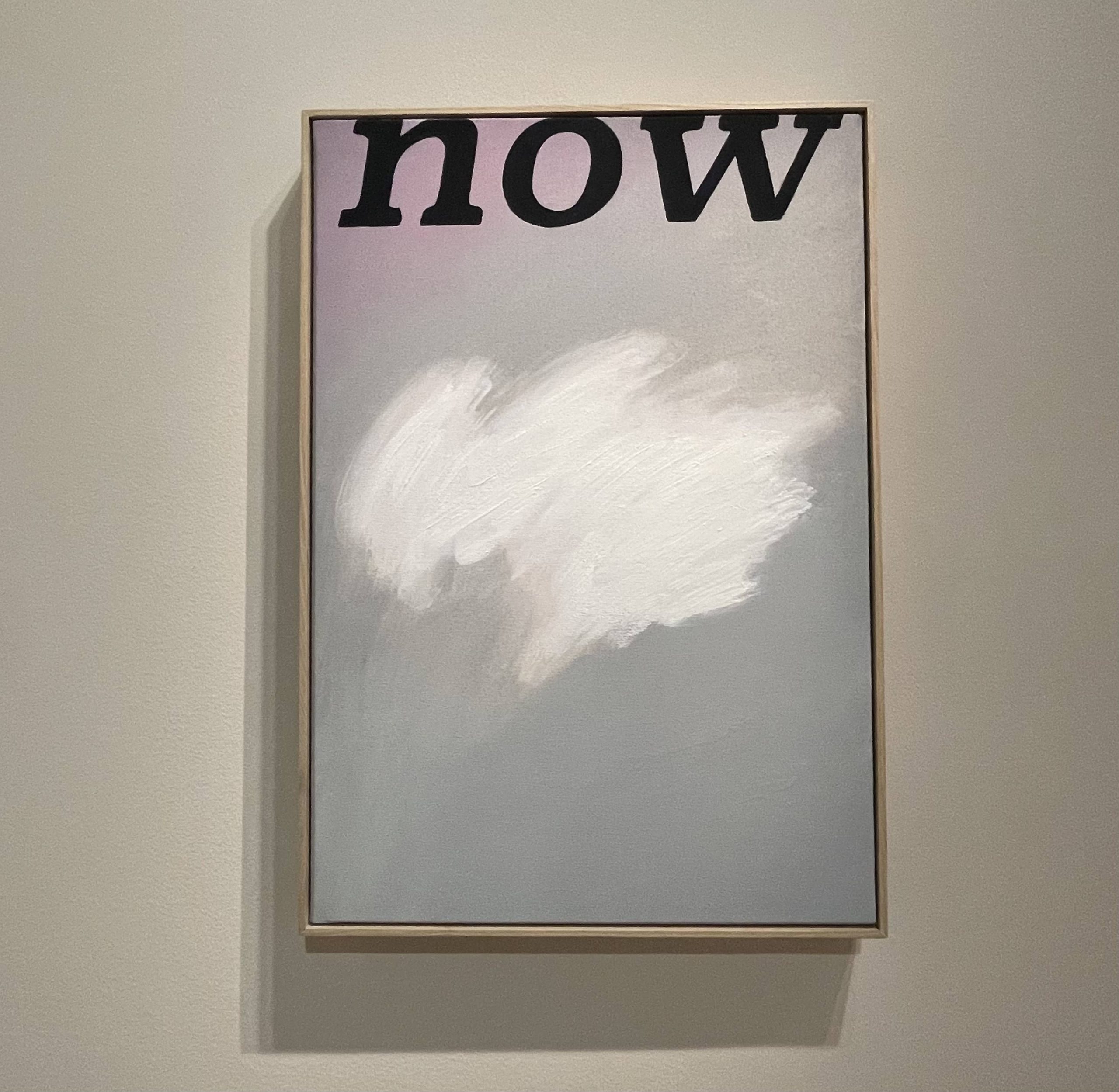
J.P.: We see the juxtaposition of your contemporary skies Now and Canaletto’s views of Venice. What does this “Now” mean to you in relation to history?
.
A.T.: Actually, what I mean is exactly what we wrote at the top: “A work of art is more contemporary to the gaze cast upon it than to the time in which it was produced.”
.
Saskia read all my studio notes, and we talked about this a lot. For me, this question of temporality is precisely that: it is the gaze that creates the present. It doesn’t matter if a work is from the twelfth, eighteenth, or nineteenth century—once we look at it, it is now. It exists in the moment we are seeing it.
.
So, juxtaposing my contemporary skies Now with Canaletto’s views allows me to reflect on what “time” really is. One could almost believe these works were made in the same period, so strongly does the gaze connect them.
.
For me, this also comes from my personal history: I was self-taught. I didn’t learn to paint “at school,” but I looked at a huge amount of painting, in books and in museums. I have always looked at periods, histories, and works as a circle, not as a linear succession. I could move from the twelfth century to the twentieth century in the same way, and it nourished my work.
.
All my series, I create at the same time. No series replaces another. They respond to each other; they continue within each other. I have the same relationship to art history as I do to my own work: it is not linear, not frontal, but horizontal. It is a dialogue that continues, always.
.
.


.
J.P.: Your series Portraits grandeur nature (2007), which feminizes the names of artists—could you talk about this idea of “rewriting” art history?
.
A.T.: When I was a child, I always wondered why, in art books, there were almost only men. All the great names I saw—the artists, the philosophers—were male. And I would think: how am I, as an artist, supposed to fit into this?
.
One day, to help students I was working with understand this, I wanted to turn things around, to feminize the names. It’s a bit like what philosophy calls a dialectic by the negative: by reversing a situation, you reveal its limits. So I took all these great names from art history and transformed them. Suddenly, it opened up another reading: one could see just how few women had been recognized in history—not because they didn’t exist, but because they had not been canonized.
.
I started this work thirty years ago, first as a large painting, a bit like a film’s opening credits with all these names. Then, gradually, I wanted to give them a presence, a face: that’s how the Portraits grandeur nature series was born. They were shown at the Centre Pompidou, where they remained on display for two years.
.
And as always in my work, the series continues. For Correspondances, I created two new portraits: Françoise Boucher and Emmanuelle Kant. These two figures embody a dialogue between the fields of art and thought—and it is also a way to extend this idea of rewriting, to make our relationship to history resonate differently.
.
.


.
J.P.: In one of the rooms, you address the question of the female body, nudity, or rather the staging of the feminine in art, past and present. How do you think your intervention modifies or questions the “viewability” of these works?
.
A.T.: Yes, I think it changes a lot, because here the dialogue between the works is really very strong, and I was incredibly fortunate to be able to create it. As I said earlier, when I saw Fragonard’s Perrette and the Pot of Milk, I immediately knew there was a correspondence with my large drawings: that small red spot, that visual detail that could establish a real dialogue between the works.
.
This painting is sublime, almost like a little operetta. It tells a very well-known La Fontaine fable from the eighteenth century, and for its time, it reflected a certain cruelty toward young girls: the milkmaid dreams, but she stumbles, breaks her jug, and loses everything—her means of living, her autonomy, her symbolic virginity. The broken jug becomes a very strong symbol of fragility and loss, and the cloud of spilled milk illustrates the disappearance of her dreams.
.
Opposite it, my large drawings show, on the contrary, an autonomous, powerful female body that gives itself birth, that exists fully for itself. This contrast creates a fascinating dialogue about the representation of the female body, its “viewability,” and the way it is staged.
.
And when I say I am a painter, even though I draw, it’s because my technique is deeply pictorial. This is not something one learns at school: I work on porous, living supports, where the gesture is free and organic. This treatment makes the body in my drawings very present and sensitive, and it resonates with eighteenth-century painting, changing the way viewers see and feel these works.
.
.
J.P.: And the small cloud painting next to the Fragonard resonates perfectly!
.
A.T.: Yes, yes, I’m very happy about that resonance. It’s a more abstract sky, but at the same time very pictorial, with a cloud that echoes the clouds in Fragonard. There are also shades of blue, gray, and pink that dialogue with the painting next to it.
.
For me, this is really everything I love to do in an exhibition: inviting the public to experience painting and pictoriality in a creative relationship. Moving from pencil on canvas to a small acrylic sky, and having it work together beyond the style or technique—that’s what matters. It’s also a way to show that painting is not just about technique or materiality: it can create a dialogue, evoke emotions, and make people feel something beyond the surface.
.
.


.
J.P.: Letters are somewhat the backbone of your creative journey. You have often worked with letters and the alphabet. How does this “language” dimension come into play?
.
A.T.: Yes… that’s a very interesting and very personal question. In fact, language has always been present in my life. I had an autistic brother who didn’t speak, so I spent a lot of time taking care of him. And I believe that really shaped the way I think about language—as a conversation that floats, which isn’t always verbal.
.
One day, an American art historian said to me about my first series Big-Big & Bang-Bang: “Yes, but this is already language; these two forms are together and they communicate.” He recognized a communication between the forms, even though there was not yet verbal language.
.
Gradually, in this long process of painting I was doing alone before having a studio, I felt the need to start writing directly on the canvas. Writing slowly became integrated into all my tools. At first by hand, and then later with typographic characters. Over time, it became central to my entire creative process and eventually permeated all my series.
.
This approach can be seen in works like the Prédalles, which resemble open books, with words sometimes split into syllables. Some series I started twenty years ago are still ongoing today; I have created more than 150, and I always have new ideas in mind. This approach is an integral part of my mental space.
.
In fact, it is about the relationship to the other, about dialogue and conversation. This dimension has been present in my psyche from the beginning, and it has gradually formalized in all my works, while retaining my unique and personal language.
.
.


.
J.P.: You highlight women artists or creators/thinking women of the period, often forgotten by art history, such as Madame de Staël, Émilie du Châtelet, Angelica Kauffmann, Adélaïde Labille-Guiard, Louise Élisabeth Vigée Le Brun. How does this translate into the hanging of the works and into your own art?
.
A.T.: Actually, with Saskia, we really wanted to show this series in that long room, which is a bit like a corridor. It works like bubbles of language, like words, like exchanges. It also refers to the salons, very important at the beginning of the eighteenth century, where women creators and thinkers would meet, discuss, and exchange ideas. These spaces were essential in giving them a place in society.
.
My Prédalles series creates a thread of speech between all these women. Even though they are silent in their picture frames, I give them a voice through my works. It’s an imaginary dialogue that crosses the centuries and connects these female figures with each other.
.
It’s also a very important room because we don’t always realize how revolutionary it was to depict a woman reading, or a woman artist, or simply a woman who thinks. For example, the portrait of Émilie du Châtelet with her compass is incredible. At the time, showing a woman thinking, working, creating, was completely unprecedented, almost subversive.
.
.

Portrait of Émilie de Breteuil, Marquise du Châtelet (1706–1749). Second half of the 18th century. Oil on canvas.
Private collection of the Château de Breteuil, Choisel.


.
J.P.: If we walk through the exhibition, we arrive in the room with the Tablettes. Can you tell us about them?
.
A.T.: This is the most recent series I started. I wasn’t necessarily trying to create a new series, because I already had all my other series keeping me busy. When I did the exhibition at the Musée Matisse in Nice, I had written fictitious letters to Henri Matisse. I wanted to illustrate them with Matisse’s cut-out gouaches, but for copyright reasons, we couldn’t use them. So, with the graphic designer I was working with, we thought of using my shapes—these letter spheres—and coloring them. It gives a kind of effect like little cut-outs.
.
While making a book, I had the idea of creating paintings from these elements. And the word “tablette” came naturally, because it evokes the Sumerian tablets: surfaces engraved with signs, writing on clay. I called this series Tablette, creating videos and paintings with a set of signs, my own organized alphabet.
.
In this room, you can see how the writing seems to emerge from the canvas and unfold around us. There is, in particular, the portrait of Adélaïde Labille-Guiard, seated at her desk writing, and it’s incredible to see this woman in full action, focused on her thought and creativity. The connection is made between my Tablettes and these eighteenth-century women who write or read, creating a living dialogue between their gestures and my contemporary work.
.
.

Agnès Thurnauer, in December 2021, in her studio in front of River Tongue, in progress. Photo: Oliver Allard


.
J.P.: At what moment did you feel that the exhibition was ready to be opened to the public?
.
A.T.: Well, believe it or not, I felt it very early. Thanks to the scenographers from Scenographia, we had plans and had started to see how the works were placed in the space. Everything was on paper, and it was funny… it was the first time I saw it “come to life” in a real way.
.
Maybe it’s also thanks to the scenography, because it allows you to mentally project the route, the museum’s volumes, and the works we had chosen. And there, with Saskia, I told her: “This room—the exhibition is already here.”
.
I think it’s a very good synergy and a real mutual intelligence with the curator Saskia. Everything developed and enriched over time, and I really feel that we created something like a haute couture dress: everything is very precise, delicate, perfectly in place. It’s work that required a lot of focus, but it was also an exceptional collaboration—very rich and very stimulating.
.
.
J.P.: In today’s context, where questions of gender, equality, and the visibility of women artists are very present, do you think your work is part of a “political” movement, or is it more of a poetic approach?
.
A.T.: It’s a bit complicated… Because language, when you work with gender and different forms, is already political. For me, language is something deeply connected to life in society, to relationships between people. In my works, whether here or at the Orangerie, these are spaces where we can be together in language.
.
So, there is a political and feminist dimension, of course, but I would also say it is humanist, in the sense of the relationship to others. I always reflect on the line that speaks to me, and I think it is both poetic and political. For me, these two dimensions converge: it is not direct activism, it is not militant in the traditional sense, but the poetry of the work carries a commitment and a reflection on the world and on human relations.
.
.

.
J.P.: To close this interview, I would like to know: by staging forgotten or invisible women, what do your works reflect about us, the twenty-first-century viewers?
.
A.T.: For me, it mainly shows that art history deserves to be revisited and reexamined. It is constructed, but we always discover new things in the periods we study. For me, the great strength of this exhibition is to show that we should not have preconceived notions about a work or a period. Our gaze is often too quick, and if we take the time to look closely, we realize we discover an enormous amount. Art history is alive; it constantly renews itself, and it is this vitality that I wish to share with the public.
.
.
J.P.: Thank you!
.
.

Agnès Thurnauer and Saskia Ooms
.
.
.
Learn more :
Agnès Thurnauer’s exhibition “Correspondences” can be seen at the Musée Cognacq-Jay in Paris from October 2, 2025, to February 8, 2026.
Curator: Saskia Ooms, curatorial assistant
https://www.museecognacqjay.paris.fr/expositions/agnes-thurnauer
Represented by Galerie Michel Rein
.
.
.

exhibition view